A Short History of Personal Journaling, From Bound Books to Digital Notes
Personal journaling has taken many forms, from bound books to digital notes. Learn how those formats preserve different parts of a life and choose one.
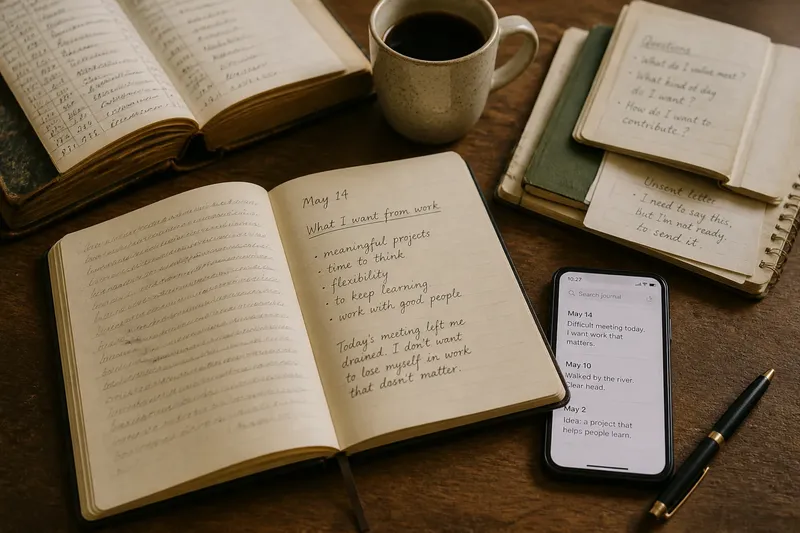
A bound notebook keeps pages together; a dated diary ties entries to particular days; a digital file makes words searchable. The history of personal journaling is best understood through these changing formats, not as a simple march toward newer tools.
Records before reflection
Writing in a notebook did not always mean keeping a private account of feelings. A single volume could serve practical purposes: recording household accounts, noting appointments, tracking a journey, or collecting observations. Such records might preserve details of daily life without being designed as a continuous personal narrative.
Bound books gave writers a physical sequence. The pages stayed together, and the writer worked with the space available, whether a page was filled or left partly blank. Accounts, lists, and personal remarks could sit side by side. The format’s continuity came from the book itself, not necessarily from a daily routine.
Dates shape diaries
A dated diary makes time the organizing principle. A date at the top of a page offers a starting point: the writer can record an event, a feeling, or a detail worth remembering. Entries do not need to form a polished story. They can preserve changes and contradictions from one day to another.
That structure can also make gaps conspicuous. A blank date may feel like a broken promise, even when the diary remains useful. Writing the next entry on the day you return is enough; there is no need to reconstruct every missed day.
Say you are leaving a familiar role and want to remember how the transition feels. You begin with an undated notebook and jot down a few notes about a difficult meeting. Next, you add the date and a short heading, “What I want from work.” The result is a dated record of that day plus a question you can find later; the tradeoff is that one notebook now holds both chronology and reflection.
Selected pages and fragments
Other forms organize writing by what the writer chooses to keep, rather than by the calendar. A commonplace book gathers passages, observations, questions, or fragments from different parts of life. Lists and unsent letters can serve a similar purpose: each preserves a particular thought without requiring a record of every day.
Loose pages and separate notebooks make it easy to keep topics apart. A page for a difficult conversation can remain distinct from a list of practical decisions. The tradeoff is retrieval: pages can drift into a drawer or bag, while a bound volume keeps them together.
A selected collection can preserve turning points without recording ordinary days. A diary gives more chronological context; a collection of fragments gives the writer more choice over what stays in view. Neither format provides a complete account of a life.
Digital journaling today
Digital journaling shifts the record from a physical page to a file or app. Depending on the tool and its settings, a writer may be able to search for a word, edit an entry, or access it on more than one device. Typing may suit someone who already uses a phone or computer to write.
Digital convenience comes with different considerations. Check how the tool stores entries, whether they sync across devices, and what privacy settings are available. Notifications and open tabs can also interrupt writing. A plain document may be easier to maintain than a feature-heavy app if all you need is a place to write and search.
Which format fits your record?
Does a dated diary suit me?
Choose a dated diary if you want to follow events in order or find dates helpful as prompts. If blank dates feel discouraging, skip them or use an undated notebook instead.
When is a commonplace book useful?
Use a commonplace book if you want to collect ideas, observations, or phrases from different sources. Add a short heading or keyword to each entry; choose a diary instead if the sequence of days matters more.
What changes with a digital journal?
A digital journal can make entries easier to search and edit, depending on the tool. Consider storage, privacy settings, and interruptions before putting sensitive writing there.
How should I choose a format?
Decide what you want to find later: a sequence of days, a set of recurring questions, or a particular thought. Match the format to that purpose, then change it if the record becomes difficult to use.
Privacy and the intended reader
“Private” describes an intention as much as a storage method. Someone who shares your home might see a paper notebook; a digital account may sync or store entries according to its settings. Keep sensitive details out, use shorthand, or write a letter you do not plan to send if that better fits your circumstances.
Writing for yourself can leave room for uncertainty. A polished account may make confusion seem settled before it is. Fragments, crossed-out lines, and plain lists can preserve what you do not yet know. Keep a form that helps you think, not one that makes the archive look impressive.
It is not worth building an elaborate filing system before you know what you want to keep. Color-coded tabs and intricate tags can become chores. A date, a short heading, or a few keywords are often enough to make an entry easier to find.
Keeping a useful record
Personal journaling has included practical records, dated diaries, selected collections, and digital files. Each format directs attention differently: a diary emphasizes sequence, a commonplace book emphasizes selection, and digital writing can emphasize search. None requires every part of a life to be recorded.
Before choosing a notebook or app, name what you hope to recover later. If you want the texture of a transition, a dated entry may help; if you want to return to a question, a heading can make it easier to locate. Personal journaling works best as a record you can adapt, not a rule you have to keep following.